

The 70% Rule for Senior Moving: How to Know What to Bring
The 70% Rule: How to Know What to Bring When Moving to a Senior Community
After helping hundreds of seniors move, we’ve found something surprising:
most people only need about 70% of what they plan to bring.
This is what we call the 70% rule for senior moving.
There’s a moment we see in almost every move…
Someone stands in the middle of the room, looks around, and realizes—everything can’t go. And, they have no idea where to start.
How the 70% Rule for Senior Moving Works
- Most seniors only need about 70% of their belongings when moving to a smaller space.
- Use simple decision filters like the First Night Test and Identifying Hidden Clutter.
- Start by focusing on what supports daily life—not everything you own.

When moving into a senior community, your new space naturally determines what will fit—and what will actually be used.
Apartments are designed differently than full homes. There’s less space, but more intention behind how that space functions.
The 70% Rule simply means this:
Most people feel more comfortable when they bring less than they expected.
Why Bringing Less Actually Feels Better
Many people assume bringing more will help them feel at home.
In reality, the opposite is often true.
When a space is filled beyond what it’s designed for:
- It feels crowded
- It’s harder to move around
- Daily routines become more difficult
When the right items are chosen:
- The space feels open
- Everything has a place
- It’s easier to settle in quickly
How to Decide What That 70% Is
✔ The First Night Test
If you wouldn’t use it your first night, it’s probably not a priority.
Think about what actually matters when you walk into your new home:
- A comfortable bed
- A lamp within reach
- A few familiar items
These are the things that create immediate comfort.
✔ The Hidden Clutter Truth
The hardest part of downsizing isn’t the furniture—it’s what’s inside it.
Drawers, closets, cabinets, and “just in case” items are where most of the extra belongings are.
This is where thoughtful decisions make the biggest difference.
When Everything Doesn’t Fit… Something Better Happens
The 70% rule for senior moving helps simplify decisions…
She stood in her bedroom, looking at everything she had planned to bring—and still believed it would all fit.
The full set.
The extra seating.
Multiple dressers.
The bench at the foot of the bed.
And everything inside them.
She kept saying she had a good eye… and you could tell she really wanted it to work.
So instead of pushing back, I grabbed a tape measure and said,
“Let’s lay it out right here.”
Standing in her current bedroom, we measured out the size of her new space directly on the floor—based on the community’s floor plan.
We marked where the bed would go.
Where the walkway needed to be.
How much room would actually be left on each side.
Then we started placing it visually around what she already had.
“This is your bed.”
“This is your walkway.”
“And this… is all the space we have to work with.”
We could see it right there in her own room—how quickly the space filled up.
And that’s when she saw it.
Not just that everything wouldn’t fit—
but that if we tried to make it fit, the room would feel tight, crowded, and hard to live in.
There wouldn’t be space to move comfortably.
There wouldn’t be space to sit and relax.
It wouldn’t feel like home.
This is what helps Seniors visualize what to bring when moving to senior living.
She got quiet for a moment.
And then she said,
“Okay… I see it.”
That’s the moment where everything shifted.
We stopped talking about what she might lose—and started focusing on what would actually support her daily life in this new space.
What she truly used.
What she truly loved.
What would make her feel comfortable every single day.
A bed she loved.
A place to sit.
The pieces that actually mattered.
From there, the decisions became clearer.
The extra furniture—the pieces she hadn’t really been using—no longer felt as important. They weren’t taken from her… they simply didn’t belong in this next space.
By the time move day came, everything we brought had a purpose.
And when she walked into her new bedroom…
The bed was made and pictures hung.
The room felt open.
There was space to move, to breathe, to settle in.
She looked around slowly, taking it all in.
And then she smiled and said,
“I LOVE it! I didn’t realize how much I didn’t need.”
But this time, it didn’t feel like letting go.
It felt like relief.
A Simple Shift in Thinking
Most people already live out of a small portion of what they own.
Instead of asking:
“What do I have to get rid of?”
Try asking:
“What do I actually use and enjoy every day?”
That shift makes decisions clearer—and far less overwhelming.
This is how downsizing for senior moving works best.
FAQ
How much should you downsize before moving to assisted living?
Most seniors find they only need about 60–70% of their belongings, depending on the size of their new space.
What should I bring first when moving?
Focus on essentials for daily living—bedroom items, clothing you wear regularly, and a few meaningful personal items.
What is the hardest part of downsizing?
Hidden clutter—items in drawers, closets, and storage spaces that accumulate over time. All those things that you think you will use “some day,” but some day rarely comes.
Helpful Resources
Download & Print:
The 70% Rule Guide Sheet
Learn More:
Senior Downsizing & Decluttering Tips
Arizona Senior Moving Company Services:
Full Service Senior Moves, Senior Downsizing, Estate Clearing
Moving into a new space doesn’t have to feel overwhelming.
When you focus on what you actually use—and what will truly fit—everything becomes clearer.
Most people don’t need everything they’ve collected over the years.
They just need the right things, in the right place.
If you’re not sure where to begin, start with the 70% Rule—and take it one step at a time.
And if you’d like a little help walking through those decisions, we’re always here to guide you so you can feel settled—not surrounded by boxes—on day one.

Celebrate National Sweet Tea Day!
There’s nothing quite as comforting as a smooth glass of sweet tea—and what better day to celebrate than National Sweet Tea Day! As you raise a glass and enjoy your favorite brew, it’s also the perfect chance to freshen up your tea collection and declutter your kitchen.
If you’ve noticed your tea stash growing a little too large or your teapots collecting dust, now is the time to downsize. Go through your cabinets and pantry to find:
- Tea, Boxes, and Tins: Get rid of expired teas or any boxes and tins you haven’t used in years. While dry tea rarely goes “bad,” its flavor fades and it’s best enjoyed fresh!
- Loose and Unwrapped Tea Bags: Toss any loose tea bags missing their wrappers or boxes.
- Unused Tea Accessories: If your teapots, serving ware, or sweetener containers haven’t seen the light of day in ages, consider letting them go.
- Heirloom and Non-Perishable Items: Don’t let treasured pieces go to waste—pass along family heirlooms or donate unused, non-perishable items so others can enjoy them too.
Clearing out the old lets you truly savor the new and rediscover favorite tea moments in your home. Downsizing is all about keeping what brings you joy and passing along the rest—either to family or to someone else who will appreciate it.
Raise your glass, simplify your stash, and make room for more sweet memories this National Sweet Tea Day!

Room-by-Room Decluttering: A Simple Plan for Seniors
Decluttering isn’t about saying goodbye to what makes your home feel like home—it’s about making space for comfort, safety, and those items that matter most. Seniors often tell us, “It’s overwhelming to think about clearing out my whole house at once,” or, “I worry I’ll regret letting go of something important.” That’s why a room-by-room approach, focused on what’s most meaningful, can turn a daunting task into a manageable, even empowering process.
Why Prioritizing Works
Instead of fixating on what to get rid of, we encourage our clients to flip the script: Start by deciding what you truly want to keep. This way, you focus on your essentials and favorites first. The rest becomes much easier to release—a method that takes the stress out of decision-making and helps you move forward with confidence.
Step-By-Step: Declutter Room by Room
1. Pick a Room to Start
Choose a room that feels least overwhelming—maybe a guest room, bathroom, or small closet.
Tackling one space at a time makes the process feel doable.
2. Identify the Most Important Furniture
Ask: What do I use every day? What feels essential for comfort and daily living?
Keep these pieces. Anything extra is now a candidate for removal.
3. Choose the Must-Have Items
For each room, set aside the items that are used often or have special meaning.
Examples: a reading lamp, a favorite blanket, or a treasured photo.
4. Remove the Rest in Stages
With your top priorities safe, review what remains.
Sort into “donate,” “sell,” “gift,” or “discard” piles.
Remember, you don’t have to decide on every item right away. Start with the obvious and work your way through as you build momentum.
5. Celebrate Progress
Seniors frequently share how lifting even a little clutter can boost their mood and energy.
Acknowledge each completed room and enjoy the extra space and simplicity.
Tips for Making Decluttering Even Easier
Work with family or trusted friends for encouragement and support.
Set a timer for each session—small, focused bursts work best.
Take photos of special items before letting them go.
Remind yourself: You’re keeping what matters most.
For more practical downsizing tips, check out our Downsizing Tips for Arizona Seniors posts. If you’re preparing for a move, our all women Arizona Senior Moving packing & unpacking team offers step-by-step support. Need help clearing out a home? See our Estate Clearing Servies for expert guidance and peace of mind.

Beyond the Dumpster: How to Simply Curate a Family Legacy From Clutter
For many seniors and their families, downsizing isn’t just about clearing out space—it’s about honoring memories and making sure cherished stories aren’t lost. “I want my grandkids to know where this came from,” is a sentiment we hear often. The good news? You don’t need fancy apps or expensive subscriptions to preserve your legacy. With a few simple steps, you can turn everyday objects into meaningful stories for generations to come.
Create Heirloom Inventories with Video Stories
You don’t have to be tech-savvy to capture your family’s history. Here’s a super simple, no-cost way to create video stories about your heirlooms:
Gather Your Heirlooms: Pick a few special items you want to share stories about, or set up your camera in a location nearby the area you are sorting and as you come across items, you can easily tell the story about them.
Set Up Your Smartphone: Use a simple tripod (or even a stack of books) to hold your phone steady.
Record Your Story: Open your phone’s video camera. Place the heirloom in front of the camera. Hit record and start talking. You don’t even have to be in the picture if you don’t want to! Just stay within 2 to 3 feet of the camera and talk loudly enough for it to be able to clearly record your voice.
Share the Story: Just talk from your heart and memories as if one of your adult children or a grandchild is there (and maybe they are) and you are telling them about it. You can share things like:
- What the object is
- Who it belonged to before you
- Where it came from
- How you acquired it
- Any special memories or stories connected to it
- Why it’s important to you
- Who you hope will keep it in the family or
- If it’s just a special memory that you’d like to share but don’t expect someone to hang onto the object
Finish and Upload: When you’re done, press stop. Watch your video and, if you’re happy, upload it to a private YouTube channel. You can share the link with just the family members you choose.
Now, your memories are preserved in a way that’s easy for everyone to access—no apps or subscriptions needed.
Tool: Digitizing Photos and Home Movies
If you have old photos or home movies, there are services that can help turn them into digital files. There are also local services that do the same, making it easy to share your history with loved ones. A Google search of “digitize photos Phoenix” (or “digitize photos [your city name”]) will list companies that offer this service so you can research for a trusted company near you. Ask your local library or senior center—sometimes they offer free or low-cost digitizing days.
Outcome: Future Generations Access Curated Archives, Not Cardboard Boxes
By taking these simple steps, you’re creating a legacy that’s more than just stuff in boxes. Your grandchildren and great-grandchildren will be able to hear your voice, see your treasures, and understand the stories behind them. “It’s not just about things—it’s about the memories and the people,” as one family shared.
Looking for more tips on making downsizing easier? Check out our step-by-step guide for seniors.
Wondering why a senior-specific moving service matters? Learn more about the difference we make.

The $200/Month Mistake: Why Storage Units Worsen Downsizing Stress
For many seniors and their families, downsizing feels overwhelming. “Where does everything go?” is a common question, and it’s tempting to use a storage unit as a quick fix. But what starts as a “temporary” solution often turns into a long-term headache—both emotionally and financially. Here’s why relying on storage units can add to your stress, and what you can do instead.
Problem: “Temporary” Storage Becomes a Long-Term Financial Drain
Many families think, “We’ll just put things in storage until we figure it out.” But as months go by, those $200+ monthly fees add up, and the boxes in storage become an out-of-sight, out-of-mind problem. Seniors often tell us, “I forgot what’s even in there,” or “I’m paying for things I don’t even want or can’t even use anymore.” It’s a common trap—storage units become a financial drain, not a solution.
Tempting, but Failed Approach: Delaying Decisions by Stashing Items Offsite
Stashing belongings in a storage unit is really just delaying tough decisions. Families say, “We thought we’d deal with it later, but later never comes.” Meanwhile, the stress lingers, and the clutter—now hidden from view—still weighs on everyone’s minds. This approach rarely leads to true downsizing or peace of mind.
Solution: Impose a 90-Day Limit and Schedule Donation Pickups or Prepare for Bulk Trash Day in Advance
Instead of letting storage become a long-term burden, set a strict 90-day limit. Mark your calendar for a donation pickup or estate sale before you even move in. Many seniors and their families find this approach gives them a clear deadline and a sense of accomplishment. As one family shared, “Scheduling the donation truck ahead of time made us actually make decisions and stick to them.”
Here’s how to make it work:
Set a Date: Choose a day within 90 days to clear out the storage unit.
Schedule Pickups or Dumpster Delivery: Arrange for donation organizations to pick up items you no longer need. Or, you can also schedule for a company like Arizona Senior Moving to do a clear-out or a Junk Hauler to simply take everything away if you do not want to rent a dumpster.
Get Support: Ask family, friends, or a trusted senior moving service to help you sort, move, and deliver items to donation or trash.
For more tips on making downsizing easier, check out our blog here.
Wondering why a senior-specific moving service matters? Learn more about the difference we make.

Is That Expired Jar of Vaseline From 1970 Still “Good”?
Spoiler Alert: It’s Time to Toss It!
Let’s be honest: we all have that one item in the bathroom. You know the one. The jar you haven’t touched in years but for some reason still holds on to the sentimental value of your “first aid kit” from decades ago. Or maybe every time you look at it you think, “I might need that someday,” but someday never comes! I’m talking about that old jar of Vaseline—and yes, the one that’s been sitting in the back of your bathroom cabinet since the 1970s.
Now, I know what you’re thinking: “It’s Vaseline! It’s petroleum jelly! It’s practically immortal!” Well, let’s take a moment to debunk that myth.
A Blast From the Past (And Not the Good Kind)
The jar I recently came across has some serious vintage vibes. This is not your run-of-the-mill modern Vaseline, folks. It’s the Carbolated Petroleum Jelly version, which is medicated and was produced by Chesebrough Manufacturing Company before they were bought out by Unilever in 1987. For context, this jar was probably made before 1974, and it’s missing one crucial thing: a barcode. (No, really. There’s no barcode. That’s how old it is!)
The formula itself contained carbolic acid, which was meant to act as an antiseptic for minor cuts and scrapes. It was a miracle back in the day. But just like your high school jeans, it’s time to let this vintage item go. Even though it’s hard to part with something that’s been there through thick and thin (literally), we can all agree—it’s well past its prime.
Why You Shouldn’t Be Sticking Your Finger in That Jar After 1970
Here’s the truth: anything you dip your finger into repeatedly should be discarded after 1 month. This comes straight from the experts, including your dermatologist. Think about it: every time you dip your finger into that jar of Vaseline (no matter how “perfectly sealed” the lid is), you’re introducing bacteria, oils, and germs. The longer you keep it, the more you’re inviting unwanted guests to party in your personal care products.
So, while Vaseline may have served its purpose as an antiseptic back in the day, it’s no longer effective and certainly not safe to use anymore. If you’ve been secretly hanging onto this jar hoping it’ll magically cure a new burn or scrape, it’s time to let go of this relic and replace it with something fresh, functional, and safe.
The Practicality of Downsizing: Out with the Old, In with the New
Downsizing isn’t just about reducing the size of your home; it’s about eliminating the old clutter and embracing what you need now. That old jar of Vaseline? It’s not doing anything for you anymore—except taking up space and adding to your stress. By parting with expired items, you’ll not only free up space but also eliminate potential health risks.
Here’s a quick rule of thumb: If it’s been in your bathroom cabinet for more than a year and it doesn’t serve a purpose, it’s time to say goodbye. The clock has run out on that item, no matter how much you may try to justify it. (Yes, even that old tube of toothpaste you swear you’ll “finish soon.”)
How to Let Go (Without Looking Back)
Take a moment: It’s okay to be sentimental. The Vaseline jar likely came from a time when you first learned how to take care of yourself. But today, you don’t need to hang onto everything that reminds you of the past.
Be realistic: That jar of Carbolated Petroleum Jelly? It’s more a part of history than anything you should be using on your skin. Toss it with confidence, knowing you’ll find a more effective (and newer) alternative.
Celebrate the space: Downsizing your bathroom can be liberating! When you finally let go of those expired products you never use, you’ll be able to replace them with fresh, efficient products that really work for you.
A Final Word: It’s Time to Let Go of the Old (and the Expired)
So, let’s raise a glass (or a freshly opened jar of Vaseline)—to cleaning out the clutter and embracing a more organized, functional space. That old jar has served its time, and it’s time to move on to something better. Whether it’s skincare products, medicines, or old beauty supplies, get rid of those expired items and feel the weight lifted.
Remember: you deserve the best, and that means saying goodbye to what’s past its prime—like that vintage jar of Vaseline—and making room for fresh, effective solutions that will actually help you today.
Looking to declutter your bathroom and home even more? Check out our Senior Downsizing & Decluttering Tips, learn about our Estate Clearing Services, or get tips on Senior Moving Services to make your transition as smooth as possible.
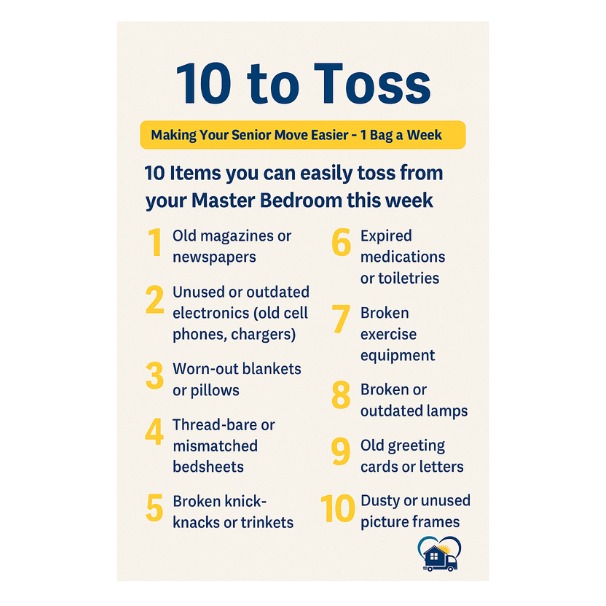
Senior Downsizing the Master Bedroom
Clear the Clutter and Rest Easier
Let’s face it—downsizing can feel a bit like tackling a mountain of laundry that’s been sitting in your bedroom for weeks. But it doesn’t have to be overwhelming! When it comes to the master bedroom, it’s not just about getting rid of stuff; it’s about transforming the space into a place where you can actually rest easier. Imagine walking into a room that’s not piled high with old magazines, mismatched pillows, and that one blanket you never really use. Sounds dreamy, right? Well, it’s easier than you think—and we’re here to help you get started. Here are 10 common items you might want to consider letting go of as you downsize:
- Old magazines or newspapers – They take up space and often aren’t read again
- Unused or outdated electronics – Old cell phones, chargers, or broken devices should go.
- Worn-out blankets or pillows – If they’ve lost their fluff or comfort, it’s time to replace them.
- Threadbare or mismatched bedsheets – A fresh set can make all the difference.
- Broken knick-knacks or trinkets – If they’re damaged or no longer bring joy, they’re just taking up space.
- Expired medications or toiletries – These not only clutter up space but can be harmful.
- Broken exercise equipment – No need to keep equipment that’s gathering dust and no longer works.
- Broken or outdated lamps – These should be replaced with functional, stylish lighting options.
- Old greeting cards or letters – Keep the memories, but recycle the paper.
- Dusty or unused picture frames – Outdated frames that no longer hold photos you love can be given away.
Clearing out these items will free up space, make your master bedroom feel lighter, and help you start fresh with only the things that truly bring value to your life. If you take on the challenge of adding 1 more trash bag to your weekly trash picup, you’ll be amazed at how much progress you’ve made even in a month of decluttering and downsizing.

Why Letting Go of a Family Home Feels Like Losing Part of Yourself
Leaving a family home or a home you’ve lived in for several years is never just about packing boxes. For many seniors and their families, it feels like leaving behind a piece of themselves-a lifetime of memories, traditions, and identity woven into every room. At Arizona Senior Moving, we understand that moving is an emotional journey, not just a logistical one. Here’s why this transition feels so overwhelming, and how you can honor your memories while making space for what’s next.
The Problem: Sentimental Attachments Run Deep
A home is more than four walls-it’s the backdrop for birthdays, holidays, gatherings, and quiet moments that define a family’s story. Every item, from children’s artwork to wedding china, holds a memory and a piece of your identity. For seniors, these belongings are tangible reminders of a life well-lived. Sorting through them can stir up grief, nostalgia, and even anxiety about losing part of who you are.
“It’s not just stuff. It’s my story, my family, my life. How do I just walk away from that?”
The Failed Approach: Rushed Purges Lead to Regret and Conflict
In the rush to meet deadlines or clear out a home quickly, families sometimes make snap decisions-tossing out or donating items without enough thought. This can lead to deep regret, family disagreements, and a lingering sense of loss. The emotional fallout from a rushed purge can last long after the move is over.
“We got rid of things I wish we’d kept. Now, every time I think about them, I feel a pang of regret.”
“My siblings and I argued over what to keep and what to let go. It made a hard time even harder.”
The Solution: Preserve Emotional Value Without Clutter
Letting go doesn’t have to mean losing everything. There are gentle, meaningful ways to honor your memories and keep your sense of self intact:
Memory Photography: Take photos of meaningful rooms, favorite nooks, and cherished objects. Create a digital or printed album to revisit whenever you wish.
“Keep Boxes”: Designate a small box for each family member to fill with their most treasured items-letters, trinkets, or a piece of childhood art. This keeps the most precious memories close without overwhelming your new space.
Memory Walls: In your new home, display a collage of photos, mementos, or a framed recipe from the old house. This brings comfort and familiarity to your new space while honoring your past.
Story Sharing: Take time to tell the stories behind your keepsakes. Record them in a journal or on video so your family can cherish them for generations.
Remember: Your memories live in your heart, not just in your belongings. Moving forward doesn’t erase your history-it creates space for new memories to blossom.
You Don’t Have to Do This Alone
At Arizona Senior Moving, we exclusively serve seniors and their families. We know how overwhelming this journey can feel, and we’re here to help you sort, pack, and preserve what matters most-with compassion, patience, and respect.
Our Downsizing & Sorting Assistance: For step-by-step support on making decisions about what to keep, donate, or let go.
Estate Clearing Services: If you need help preparing a home for sale after a move.
Packing, Unpacking & Settling In: See how we help you create a warm, familiar space in your new home.
Senior Moving Tips & Resources: More advice on handling the emotional side of moving.
Testimonials: Read stories from families who’ve made the transition with us.
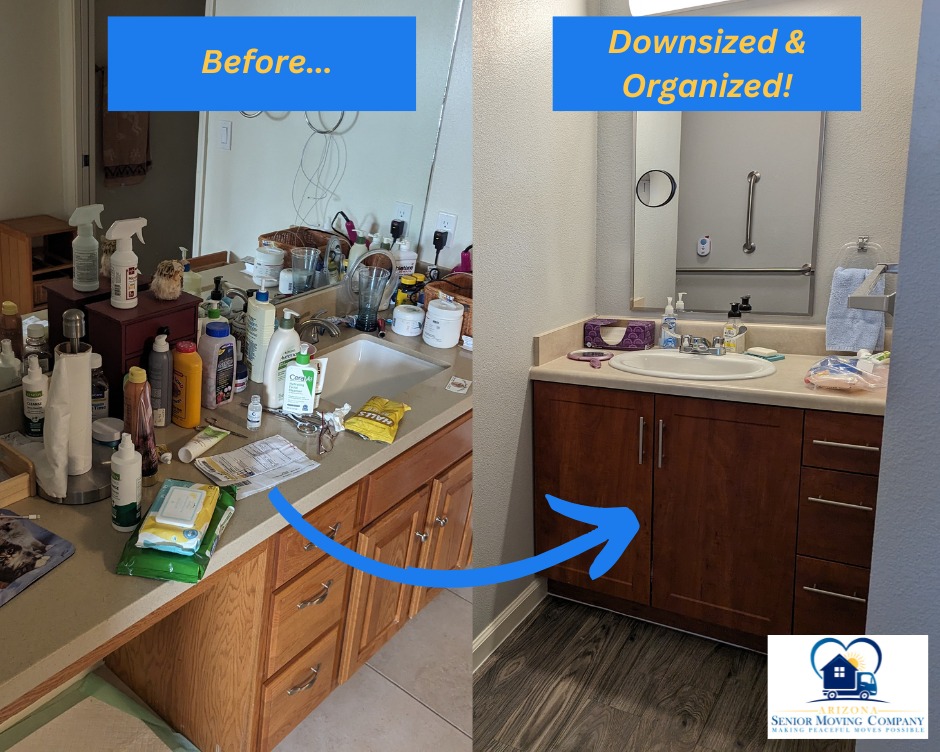
5 Essential Downsizing Tips for Seniors Moving to a Smaller Home
Moving to a smaller home can feel overwhelming, but with the right plan, seniors can downsize smoothly and stress-free. Here are five expert tips to help make the transition easier.
1. Start Early & Take Your Time
Begin sorting through your belongings at least 3-6 months before your move to avoid last-minute stress.
2. Prioritize Sentimental & Essential Items
Keep cherished memories and functional items that will fit your new space. Consider donating or gifting other belongings to loved ones.
3. Measure Your New Space
Make sure your favorite furniture and decor fit comfortably in your new home before moving.
4. Seek Professional Help
Companies like Arizona Senior Moving Company specialize in helping seniors downsize with care and efficiency.
5. Embrace the Next Chapter
Downsizing is an opportunity to enjoy a simpler lifestyle with less clutter and more freedom.
Need expert downsizing help? Arizona Senior Moving Company is here to make your transition stress-free. Call us today for a free consultation! 602-620-9941

Senior Downsizing Myths Debunked – The Truth About Simplifying Your Life for Seniors
Senior downsizing can feel like an intimidating task, especially for seniors transitioning to a smaller space or a senior living community. Misconceptions about what it means to downsize often lead to unnecessary stress and hesitation. But the truth is, senior downsizing isn’t about loss—it’s about gaining a simpler, more manageable lifestyle. In this post, we’ll debunk common senior downsizing myths and show you how to embrace the process with confidence.
Myth #1: Senior Downsizing Means Losing Everything You Love
One of the biggest fears about senior downsizing is parting with sentimental items. However, downsizing isn’t about giving up everything you love; it’s about focusing on the things that truly matter.
The Reality: Senior downsizing allows you to prioritize cherished belongings. Whether it’s a family photo album or a favorite piece of furniture, the goal is to create a home filled with meaningful items.
Pro Tip: Use creative solutions like shadow boxes or digital photo frames to preserve and display memories in smaller senior-friendly spaces.
Myth #2: Senior Downsizing is Only for Financial Reasons
Many seniors believe downsizing is solely about saving money, but the benefits extend far beyond finances.
Reality: Senior downsizing can improve quality of life by reducing home maintenance, increasing safety, and offering opportunities to live closer to loved ones or in a more supportive senior community.
Pro Tip: Look at senior downsizing as an investment in peace of mind and a simpler lifestyle, rather than just a financial decision.
Myth #3: Senior Downsizing is Too Overwhelming to Handle
It’s natural to feel overwhelmed when facing years of accumulated belongings, but you don’t have to do it alone.
The Reality: Breaking the senior downsizing process into manageable steps and seeking professional help can make it smooth and stress-free.
Pro Tip: Senior moving specialists, like Arizona Senior Moving Company, can guide you through each step, from sorting items to settling into your new senior-friendly home.
Myth #4: Family Will Take Care of Everything
While family support is valuable, relying solely on loved ones can be challenging for both parties.
The Reality: Families often have busy schedules and may not have the expertise to handle a senior move efficiently.
Pro Tip: Hiring senior moving professionals ensures that the process is handled with care and attention, relieving both you and your family of unnecessary stress.
Myth #5: Moving to a Smaller Senior Home Means Sacrificing Comfort
Senior downsizing doesn’t mean you’ll lose the comfort of your current home—it just means reimagining it on a smaller scale.
The Reality: A thoughtfully planned senior-friendly space can be just as cozy and functional as a larger one. With the right furniture and organization, small spaces can feel open and inviting.
Pro Tip: Consider multipurpose furniture, like ottomans with storage or foldable tables, to maximize space while maintaining comfort.
Senior downsizing isn’t about sacrifice—it’s about making intentional choices that lead to a more manageable and fulfilling lifestyle. By letting go of misconceptions and seeking the right support, you can transform senior downsizing into an exciting new chapter. If you’re ready to embrace the benefits of senior downsizing, Arizona Senior Moving Company is here to help. Contact us today for compassionate, expert assistance that takes the stress out of moving.