

Top 7 Reasons Seniors Downsize
Like many things in life, there are no courses or manuals for making some of its most important decisions. Whether they’re emotional or financially driven, or a combination of both, sometimes you just have to go with your gut. And while there’s no easy answer, recognizing your motivations for downsizing can help you make the final decision on whether it’s time to stay or go.
Financial stability: Are you retired or experiencing financial hardships? Have your monthly expenses increased over the years due to the escalation in the cost of living? If so, this may be an opportune time to downsize, especially If you’re feeling a financial crunch. Selling your home for a smaller, lesser expensive place can help you to save money, reduce your monthly expenses, and possibly increase your disposable income.
Home equity: If you’ve owned your home for several years, there’s likely a lot of equity, particularly with the rise in home prices over the past few years. This may be a great reason to sell as you can use the proceeds from the sale to downsize and have some cash left over to add to your nest egg.
Homeownership: Are you tired of being a homeowner and no longer want the responsibilities of the upkeep or ongoing expense? Whether it’s due to financial, physical, or other circumstances, it may be a good time to discuss selling and explore rental options or consider a Senior Living Community.
Home upkeep: Having less maintenance is often the key reason for downsizing. Not only can it be costly, but it can also be dangerous. For example, if you’re older and have to climb on your roof to clean the gutters, you may be putting yourself at risk of a serious fall. If you’re beginning to feel overwhelmed with your home’s upkeep, it may be a good time to consider a downsizing move.
Life changes: Unexpected major life-changing events, such as divorce or the death of a spouse or partner or an illnes or injury, may require you to make some changes, both in your financial life and your lifestyle. They may even be the catalyst for making your final decision to downsize.
Lifestyle: Have you aged out of your neighborhood? Are you an empty nester and your home now feels lonely or too big for you? If so, it may be time to consider downsizing to a smaller home and into a community that makes sense for you. There are many options in the Phoenix and Sun City area for Active Adult Communities and Senior Communities that match your financial and lifestyle needs with other like-minded people.
Proximity to family: Your adult children and grandchildren may not live close to you anymore and chances are you want to be in closer proximity to them. Whether you’re retired or still in the workforce and able to work remotely, it may be the right time to sell and downsize.
If you’ve decided to begin the downsizing process, be thorough in your research—the options are endless. Whether your motivations have to do with a lifestyle change, lower cost of living, or health challenges, be sure to contact Arizona Senior Moving to assist you in your downsizing adventure “Home upkeep: Having less maintenance is often the key reason for downsizing.” “Life changes: Unexpected major life-changing events, such as divorce or the death of a spouse or partner, may require you to make some changes, both in your financial life and your lifestyle.” .
,
How To Be In The Top 15% of Women With Your Shoe Collection
“According to a recent study by ShopSmart magazine, the average American woman owns 19 pairs of shoes, with 15% of women owning 30 or more pairs. How did I compare? Surely, not being a shoe person, I should be safe. So I counted the shoes in my closet. After about a dozen boots, 10 pairs of flats, and an assortment of wedges, pumps and sandals, I was fast approaching a total of 30 – and the prospect of officially being a “shoe girl.” Dreading this harsh reality, I simply skipped over several pairs of shoes that I intend to throw out at some point soon (just not today; I might need them!). Then I realized maybe I was – gulp – one of them. I had too many shoes” (Blake, 2008).
Sound familiar?
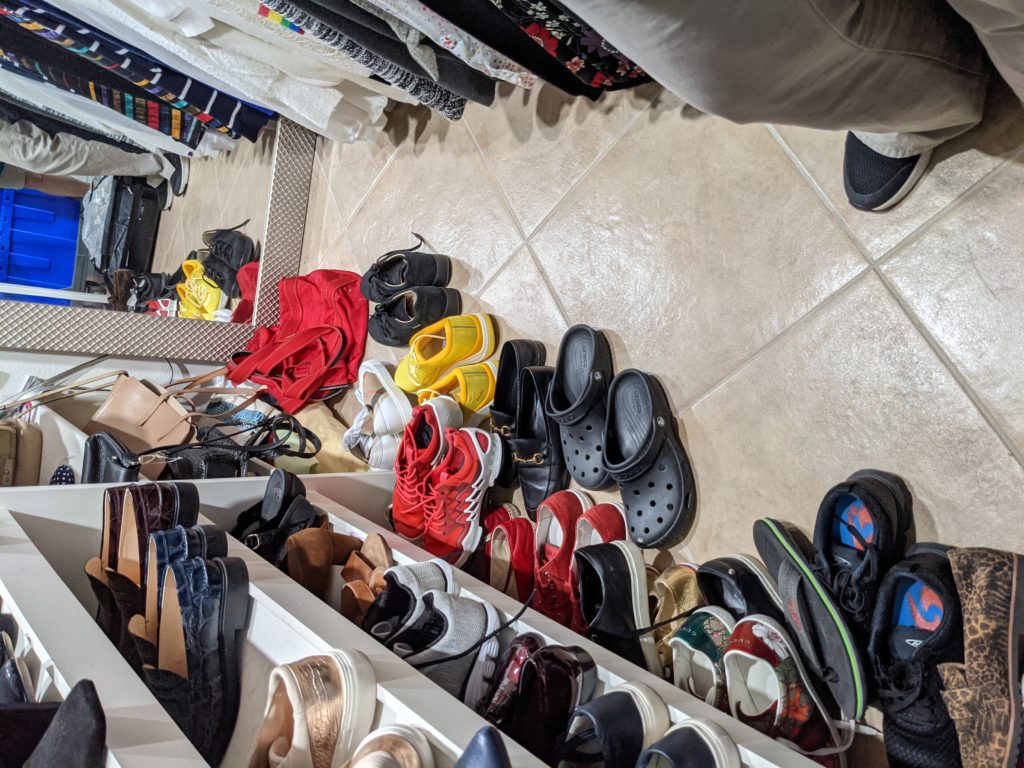
You open your closet, the prospect of moving to your new apartment in a senior community you’ve chosen motivating you to start packing and sorting through your belongings, only to be intimidated by the very first thing you see: Your shoe collection.
Shelf after shelf, stack after stack, shoes piled everywhere. Heels, flats, sneakers, and boots.
You lose count around fifty pairs, overwhelmed by the sheer amount of footwear you accumulated over the years.
Congratulations! You’re in the top 15% of women with a shoe collection!
So, intimidated by the prospect of having to sort through your shoes alone and struggling to choose the best pairs to take? Call Arizona Senior Moving Company! Our team of ladies will help you not only sort through your shoes, but also pack and organize the rest of your house so that you have as peaceful of a move as possible.

Operation Declutter
What words would you use to describe your home? If you said peaceful, clean, inviting, or organized, congratulations—it sounds like you’ve cracked the declutter code. If you said chaotic, overwhelming, or messy, let’s chat. Of course, it’s perfectly natural for your home to alternate through phases of clean and cluttered; we’re human, after all. Here are some strategies for streamlining your space.
ENTRYWAY: Establish a landing area for your keys, wallet, purse, and shoes. A console table with a small bowl can hold keys, or a tiny hook in the wall will suffice if the space is small. If you don’t have a coat closet, install coat hooks along one wall and slide a shoe rack underneath it.
KITCHEN: Let the decanting begin! Choose some jars of various sizes to hold grains, nuts, seeds, pasta, and flour. To store smaller amounts, you can save money by soaking off the labels of pasta sauce or pickle jars. This will not only make your pantry look more cohesive but also make it much easier to know what you need at the grocery store to replenish your supplies.
LIVING ROOM: One word: curate. Pretend you are staging your living room as if it were an Airbnb. How do you want guests to feel in the space? What could you get rid of to make the room more livable and inviting? If you’re holding onto knickknacks solely out of guilt, give yourself permission to toss them.
BEDROOM: Are you overwhelmed by the amount of clothing in your closet? Consider a capsule wardrobe of thirty coordinated pieces that will make getting ready for the day much simpler. Try designating a “maybe” bin if you have trouble being decisive. If you don’t miss the items of clothing in the bin after a few days, you know it’s time to donate them.
BATHROOM: Change your habitat instead of your habits. If your dirty clothes always find their way onto the bathroom floor, move your laundry hamper into the bathroom. Do you have half-full bottles of shampoo that you used and didn’t like or face masks gifted to you by well-meaning friends? To paraphrase Elsa from Frozen, “Let them go!”
Think of decluttering as a journey and not a destination. It’s a constant process of assessing your habits and establishing systems, like taking out the trash every Tuesday or hanging up three shirts before going to bed. Instagram is a great resource if you are someone who likes to follow a plan. Search #declutterchallenge for weeklong, monthlong, or even yearlong strategies. Or commit to a “no-buy month” (other than essentials) and get to the root of your motivation to accumulate. Go forth and declutter!

Downsizing Your Recipes

Gift Wrapping Downsize
How Seniors Can Sell Items on Facebook Marketplace (part 2)
In Part 1 of this series, we discussed some of the terms that are important to know for Seniors selling their belongings on Facebook. In Part 2, we will cover 3 important elements of your listing on Facebook Marketplace so you can sell your items quickly.
Items
Avoid the urge to overload your listing with too many different items. It’s better to group like items together in a listing. So, you may have a listing of a small group of stereo equipment and speakers together. But, you don’t want to have a stereo, speakers, silk flowers, and a set of china in the same listing. When you group your similar items and list them in separate listings, you are making it clear what you’re selling and it will make it easier to mark as pending or sold. It will make it easier for buyers to make offers, as well.
Working Condition
It’s important if you want to make money on your Facebook Marketplace listings that the items you are selling are in working condition and free of significant structural damage. Otherwise, you need to sell it as is or as parts. Be honest with yourself if the item has damages and reduce your price significantly or list it as free. There is a market for damaged items that can be refurbished, but buyers will be picky about prices.
Photos
Facebook allows 10 photos per listing. If at all possible, use all 10 photos. Take quality photos from different angles. If there is any kind of signature or maker’s mark on your items, take clear pictures of them. Make sure that all pictures are clear and highlight any damages or signs of use. The more photos you have, the more likely people are to look closely at the item and consider purchasing it.
Using natural lighting to take your pictures is a great idea. Put your item near a window and stand on the same side as the window to take the photos. If you’re handy with any editing software, you can label different parts of your item or mark the measurements on the photo as well.
Pricing
The price you list your item for should reflect its value minus damages, normal wear and the demand for it. It’s up to you how much you list your item for, but be careful not to go too high because buyers do their research and won’t go for items listed at an unreasonable price. If you are putting all the effort into creating your listing, you want to have the best opportunity to make a bit of a return on your item. Do your research and price fairly!
In Part 3 of this series on selling on Facebook Marketplace, we’ll discuss the rest of the items you need to include in your listing.
How Seniors Can Sell Items on Facebook Marketplace (part1)
Oftentimes, Seniors ask us about selling their unwanted belongings on Facebook Marketplace. When furniture and other items will not fit in an Assisted Living apartment, decisions have to be made about what will go to donation and what will be sold. In this 3 part post, we will cover what Seniors need to know to sell on Facebook Marketplace.
General Lingo
There are a few phrases and abbreviations to learn so you can navigate Facebook Marketplace effectively. These are words that buyers use while searching. You may not use all of them in your listing, but you do need to know them so that you will know what buyers are talking about when they contact you using some of this lingo.
OBO
You might see OBO in the description of a listing. Here’s an example:
“$20 OBO”
This abbreviation means “or best offer.” A buyer may want to know what the best offer is that you have received so far before they give you their offer.
PPU
This is referring to the method of picking up the item purchased. It means Porch Pick Up. It is a commonly used when people prefer contactless transactions. Your buyer may prefer to come and pick up their purchased item from your porch or driveway.
Meet Up
If you prefer to meet at an agreed upon public place to ensure safety, you would use this term in your listing.
ISO
“In search of” or ISO might be listed under items that people are giving away as a trade. Their listing might say something like: “Looking to trade my antique lamp ISO a nightstand.”
Pending
When you have an interested buyer, you might label the listing as “pending” which will indicate that if the sale falls through, it will still be available. This way you can contact the next possible buyer in the list if the sale does fall through. Buyers will use the save button to check back and see if the item becomes available again.
In Part 2, we’ll explain some of the specifics to consider and include when creating your listing.
Downsizing Doesn’t Have To Be Lonely
You want family and friends to come and visit you in your new Assisted Living Community, right? Here are some tips to not only plan for visits, but to plan for your comfort and safety as well. Senior Downsizing is joining a community to increase social interaction, as well as to continue to enjoy your family and friends. This video is a summary of the important points in the article published on here.
Are you experiencing the endowment effect?
What To Do With All of Our Belongings?
Sorting and Dispersing
Having a Senior Move Manager assist you with sorting and organizing all your belongings and things you have collected over the years will be a great benefit for you. They will provide extensive experience and care in the best ways and methods to use to proceed through your belongings in a manner that is compassionate about the process of sorting through memories while respecting your budget and completing the job in an efficient manner. The Senior Moving Manager will also keep an inventory of all your household goods to ensure safe delivery and accounting for each item.
As part of the Sorting and Organizing process, the Senior Move Manager will help you make decisions on what items will be relocated to family members or friends, what items will be donated, possible items for sale and the items that will need to be disposed of. They will also supervise the process and set up the logistics for making sure each item gets to its intended destination.